Mall Customer Segmentation
This project was completed during my final year at Symbiosis School for Liberal Arts as part of a business analytics coursework in a group of 3. It involved applying data analytics tools like Python, SQL, Power BI, and machine learning to solve a real-world problem.
Project Type
Data Analytics Report
Date
May 2025

Tools Used
Python · SQL · Power BI · Machine Learning
Dataset
Project Overview
To apply data analytics techniques for solving a real-world business challenge: segmenting customers of a hypothetical mall using demographic and behavioral data to enhance marketing effectiveness and resource planning.
Problem Statement
Elite Mall struggled with:
-
Inconsistent customer engagement
-
Broad, ineffective marketing campaigns
-
Lack of insights into customer behavior
Goal: Use K-Means clustering to identify unique customer segments and provide actionable recommendations.
SMART Objectives
Specific: Segment customers based on demographic and behavioural features: age, annual income, and spending score: using clustering techniques.
Measurable: Evaluate clusters based on mean values of key variables, customer counts per segment, and visual separability.
Achievable: Utilise a clean, structured dataset of 200 customers with no missing data and a manageable number of attributes.
Relevant: Directly support the mall's business goals by enabling personalised/targeted marketing campaigns, optimised store layouts, and strategic promotions, thereby optimising resource allocation and improving marketing ROI.
Time-Bound: Complete the analysis and documentation before the May 10, 2025, project deadline.
Data Collection & Preparation
-
Source: Kaggle dataset (200 records) with fields: Customer ID, Gender, Age, Annual Income, Spending Score
-
Cleaning & Processing:
-
Renamed columns for clarity
-
Checked and confirmed no missing values
-
Created Age Groups and Income Brackets
-
Scaled features for clustering
-
-
Tools Used: Python (Pandas, Seaborn, Scikit-learn), Power BI
Exploratory Data Analysis (Python Visuals)
-
Descriptive statistics and univariate visualisations
-
Clustering Technique: K-Means (Feature Scaling, Elbow Method)
-
K-Means Application
Distplots: Univariate Visualizations

Gender-Based Analysis (Count Plot)
Distribution of Age, Annual Income and Spending Score (Histograms)


Key Insights
-
Spending behavior is bimodal: clear groups of high and low spenders
-
Younger shoppers (20–35) spend more, regardless of income
-
Gender differences exist, with females slightly more engaged
Customer Segmentation (K-Means Clustering)
-
Features Used: Age, Annual Income, Spending Score
-
Elbow Method: Optimal clusters = 5

-
Profiles Identified:
-
Cluster 1: Young, low-income, high spenders
-
Cluster 3: Young, wealthy, top spenders
-
Cluster 4: Wealthy but frugal (disengaged)
-
Cluster 2 & 0: Moderate spenders across different age groups
-
Cluster 5: Low-income, low engagement

Dashboard Insights (Power BI Visuals)
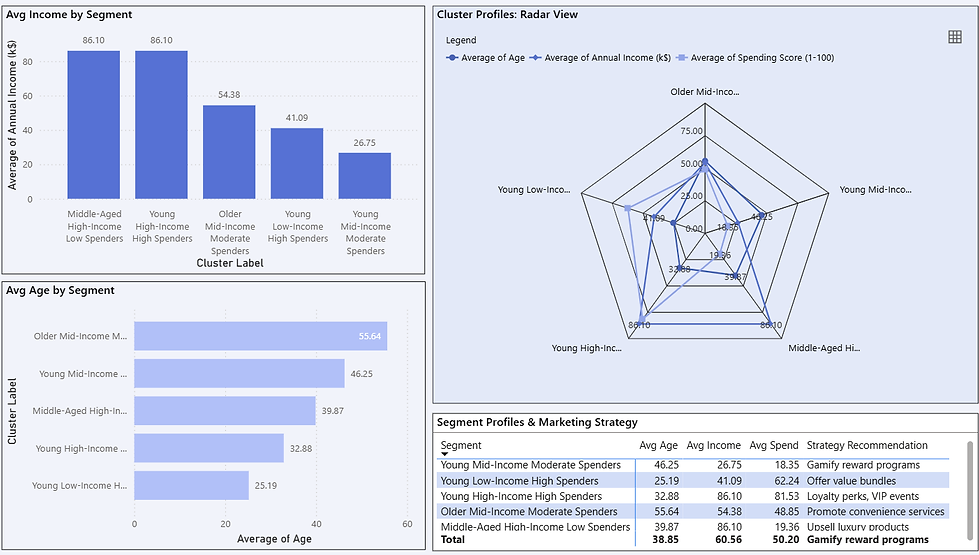
This project applies K-Means clustering to segment 200 mall customers based on age, income, and spending habits. Using Python, SQL, Power BI, and machine learning, five unique customer profiles were created to drive strategic marketing decisions.
Key visuals include KPI cards, pie charts, scatterplots, and radar charts to reveal insights like:
-
Cluster 3: Young, high-income, and top spenders → target with VIP services
-
Cluster 1: Low-income but highly engaged → target with influencer campaigns and value deals
-
Cluster 4: High-income, low-spending → re-engage with personalized experiences
The dashboard empowers Elite Mall to move from broad campaigns to targeted actions, improving engagement and ROI.
.png)
.png)
Business Strategy Recommendations
-
Use behavioral segmentation, not just demographics
-
Prioritize Clusters 1 & 3 for immediate growth
-
Reactivate Cluster 4 with curated offers
-
Redesign mall layout & experiences based on top segments
Outcome
This project demonstrated how data-driven customer segmentation empowers more personalized marketing and operational strategies. By combining Python and Power BI, we transformed raw data into real business insights, helping the mall align with consumer behavior and optimize performance.